Compliance
Designing a GDPR-ready social screening workflow
A practical blueprint for lawful basis, proportionality, and human oversight in social media risk analysis.
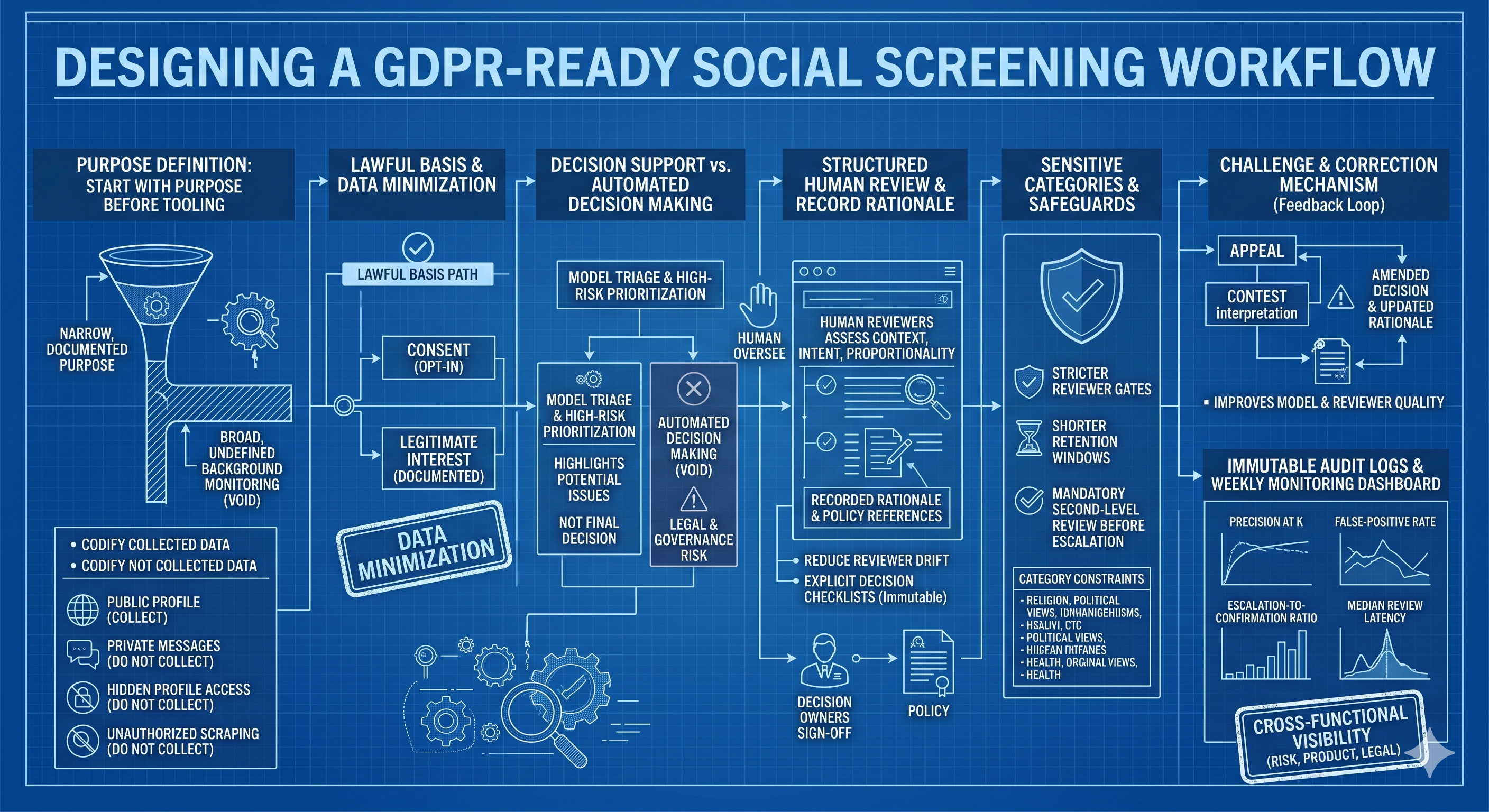
Start with purpose before tooling
A compliant workflow begins with a narrow, documented purpose. If the objective is suitability for a specific role or safety-sensitive function, the screening scope should map directly to that purpose. Broad, undefined background monitoring is hard to justify under data minimization principles.
In operational terms, this means codifying what you will not collect as clearly as what you will collect. For example: no private messages, no hidden profile access, no scraping outside authorized scope, and no retention beyond documented necessity.
Separate decision support from automated decision making
Many teams unintentionally cross the line from analyst support to automated decisioning. If a model output is treated as final without meaningful human review, you create both legal and governance risk. High-impact decisions should remain reviewable and challengeable by design.
Keep a clear handoff: model highlights potential issues, human reviewers assess context and record rationale, and decision owners sign off with policy references. This creates a defensible trail for audits and individual requests.
Encode legal basis and category constraints in the product
Consent and legitimate-interest pathways should not be left as informal checkboxes in documents. They should be represented in system state: who initiated the scan, what basis was used, what categories were enabled, and when the data must expire.
Sensitive categories need explicit safeguards. Even when local law allows processing under strict conditions, teams should default to stricter reviewer gates, shorter retention windows, and mandatory second-level review before escalation.
Build for challenge and correction
A compliant pipeline includes mechanisms for correction, context, and appeal. People should be able to contest a flagged interpretation and provide missing context. Without this, false positives become permanent reputational artifacts.
From an engineering perspective, this means immutable audit logs plus reversible outcomes: decisions can be reviewed, amended, and re-exported with updated rationale. Transparency and reversibility are not just legal niceties; they improve model and reviewer quality over time.
References
- General Data Protection Regulation (EU) 2016/679 (Official Text PDF)
Primary legal text for GDPR obligations, including principles, lawful basis, and data subject rights.
- EDPB: Automated Decision-Making and Profiling Guidelines
Supervisory guidance on profiling, solely automated decisions, and safeguards under GDPR.
- NIST AI RMF 1.0 (2023)
Useful governance structure for integrating legal, technical, and process controls.
- EEOC: Employment Tests and Selection Procedures
US guidance on adverse impact and defensible selection procedures in employment contexts.